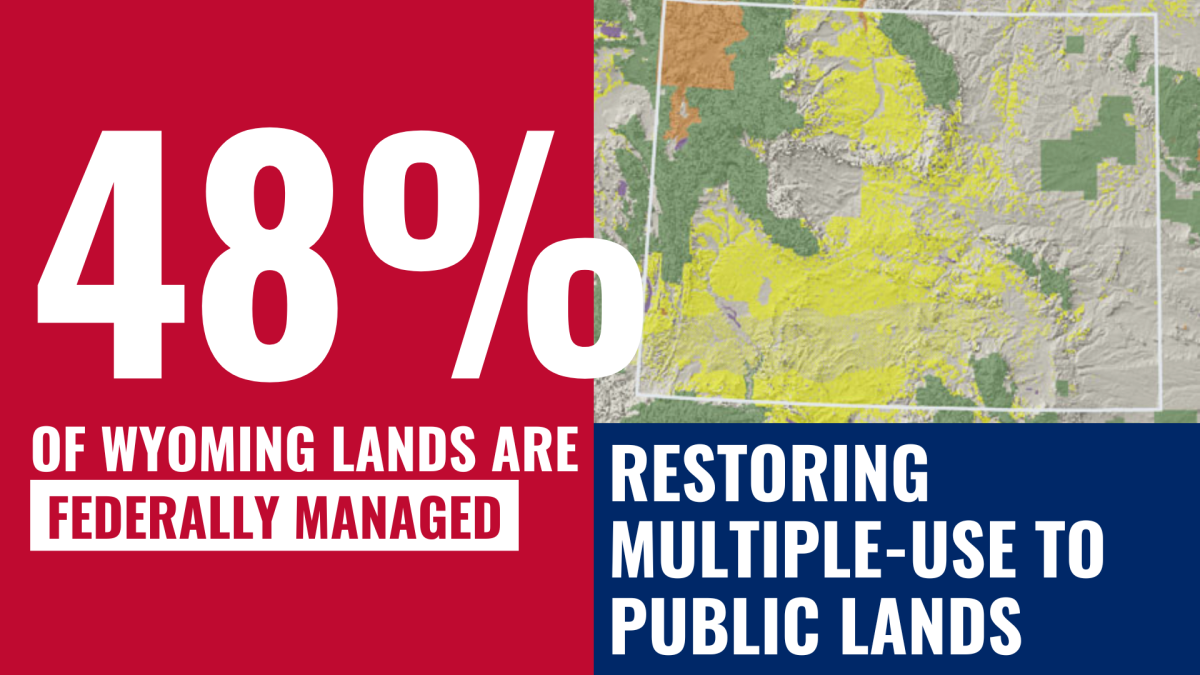
Restoring Multiple-Use to public lands
I practiced as a water, natural resources and constitutional attorney for over 30 years, defending private property rights and responding to bureaucratic overreach. I have worked hard to protect the resources we have been so richly blessed with in Wyoming, both as an attorney and as your representative in Washington, D.C. I have consistently advocated for the “multiple use and sustained yield” approach to land and water management, prioritizing access, responsible development, and effective conservation.
The federal government owns approximately 640 million acres (28%) of the U.S. surface estate, with 96% of those lands located the West. In Wyoming, roughly 48% of our surface estate is under federal management, as is over half of our subsurface (mineral) estate. There are many dedicated public servants who work in Wyoming and other states, managing our rangeland, forests, and national parks, but the reality is that these lands are ultimately controlled by federal agencies located in Washington, D.C., and are susceptible to being—and have been—politicized and bureaucratically mismanaged.
The federal government is not history’s greatest land manager. Thanks to numerous inefficiencies, built-in delay, pure inertia, and decision making based on politics rather than sound science, Washington, D.C.’s management and oversight of faraway lands is a national tragedy, largely imposed by the very people who claim to be “environmentalists.”
Let’s take just the 2001 Clinton roadless rule (which essentially blocked access to 58.5 million acres of federal land, according to the USDA) as an example: millions of National Forest Service acres have since burned to the ground as the direct result of a beltway decision made by the U.S. Forest Service (not Congress) to prohibit the construction of the necessary infrastructure—roads—to maintain forest health. Nine of the ten most catastrophic forest fires have occurred since adoption of the roadless rule. The rampant insect infestation—which the Forest Service well knew would plague our mountains if the roadless rule went into effect—has destroyed industries, small towns and adjacent private property alike. Rich critical mineral reserves and energy resources are locked away, keeping local communities from pursuing economic growth.
The government’s creation of programs like Secure Rural Schools and Payment in Lieu of Taxes is a recognition that the federal holding of such vast amounts of western lands disadvantages states and municipalities. There are communities in Wyoming and other western states struggling to grow and benefit from new economic opportunities because no land is available for private development or housing, with even the most benign local request (such as seeking approval to clear power line rights-of-way to prevent the sparking of forest fires) taking over three decades. National parks and wildlife refuges also suffer under colossal maintenance backlogs in the billions of dollars.
As your representative, I am leading that charge. I want to make our public lands work better for all Americans, to enjoy the fruits of our abundant resources, and to ensure those same gifts are available for each generation to come.
I have never voted for the “mass selloff” of our public lands, a fact that is directly contrary to the claims being spread by fearmongering radicals who ultimately seek to block all access to and use of our federal lands, while conveniently fundraising off their dishonesty. I have voted and advocated for a modernized and robust governance structure that engages with the states, local communities, and all stakeholders, while also adhering to statutory multiple use mandates, and the implementation of true conservation and maintenance activities.
I am sending you this letter to put concerns to rest, address misunderstandings, and to tell you what I have done to protect and preserve public lands in Wyoming and across the country.
As a Natural Resources Committee member and Chair of the Water, Wildlife and Fisheries Subcommittee, I have:
- held a well-attended and well received field hearing at Grand Teton National Park to urge reauthorization of the Great American Outdoors Act to provide funding for the maintenance backlog on public lands, including our beautiful national parks;
- conducted oversight and investigation into the $2 billion deferred maintenance backlog on the National Wildlife Refuge System impacting access, while developing real solutions to address this issue;
- cosponsored the Fix Our Forests Act, a bipartisan bill to restore forest health, increase resiliency to devastating wildfires, and protect at-risk communities;
- voted for the EXPLORE Act to improve public lands access, modernize technology for visitor experience, streamline small business operations on public lands, restore campgrounds, and more;
- voted for the Wetlands Conservation and Access Improvement Act to reauthorize supplemental funding for the Wildlife Restoration Fund to support wetlands conservation and hunting;
- voted for the Save our Sequoias Act to conserve giant sequoia trees by declaring an emergency on select public lands, such as Yosemite National Forest, Sierra National Forest, and more;
- passed into law H.J. Res. 130 overturning the Buffalo Resource Management Plan amendment that violated federal multiple use mandates to stop all coal production in the Powder River Basin;
- voted to create the Chiricahua National Park in Arizona;
- introduced H.R. 7695 to repeal the 2001 Clinton Roadless Rule and, once again, allow for the healthy and effective management of our forests;
- voted to provide the National Park Service expedited authority to restore forests, structures, and assets within areas of the Grand Canyon National Park impacted by the Dragon Bravo Fire;
- worked with local stakeholders and the Department of the Interior to pause the implementation of the Rock Springs Resource Management Plan amendment that was designed to block recreational access and multiple use;
- voted to increase motorcyclist access to national parks by requiring the America the Beautiful Annual Pass to permit the admittance of two motorcycles into national parks;
- introduced H.R. 281 to celebrate the Endangered Species Act’s successful recovery of the Greater Yellowstone Ecosystem grizzly bear by officially delisting the bear to state management;
- introduced H.R. 775 to institute a federal no net gain policy that would require the Departments of Agriculture and the Interior to dispose of lands equal to new lands acquired;
- cosponsored the SPEED Act to reform abuses under the National Environmental Policy Act that prevent our country from caring for our public lands, harvesting our resources, and meeting the demands of the modern economy;
- cosponsored the Making National Parks Safer Act which directs the National Park Service to develop a plan to install Next Generation 911 systems for better emergency assistance response; and
- introduced H.R. 5910 to extend to all federally recognized Native American tribes long term leasing authority in line with modern business contracts to increase economic opportunity.
I participated in several hearings directed at improving the health of our federal lands and water resources, with a special emphasis on ensuring our agencies are accountable for the decisions they make and responsive to what our states and local communities need.
Correcting the Record on Public Land Sales
You may be familiar with reporting from the summer of 2025 on a proposal to direct the Bureau of Land Management and Forest Service to work with states and local communities to identify parcels of adjacent or nearby federal lands that could be considered for sale for housing and to meet other local needs. This idea was put forward by the Senate Energy and Natural Resources Committee during the budget reconciliation process, with a focus on those communities that are “federally landlocked,” meaning surrounded by federal lands making it difficult for communities to grow. The Town of Kemmerer is an example of a Wyoming municipality that is struggling to provide housing for the many people who work in the area. The BLM owns many vacant lots in the City of Las Vegas and elsewhere, the disposal of which would also make sense, both economically and because these lands do not further the agency’s mission nor provide anyone with hunting, fishing, camping or grazing opportunities. This was a Senate proposal and was never addressed by the House of Representatives. It never received a vote in either chamber, and I have never voted for the mass sale of public lands.
There is a strong consensus that we must better manage our public lands for the benefit of all who enjoy them and preserve them for generations to come. I have fought for this exact approach for decades. In short, I do not believe that creating the conditions for catastrophic forest fires, insect infestations, the explosion of invasive plants, and blocking access to millions of acres of federal lands by making it impossible to get to them is smart land management. I will continue to advocate for Wyoming’s interests when it comes to these important issues.